

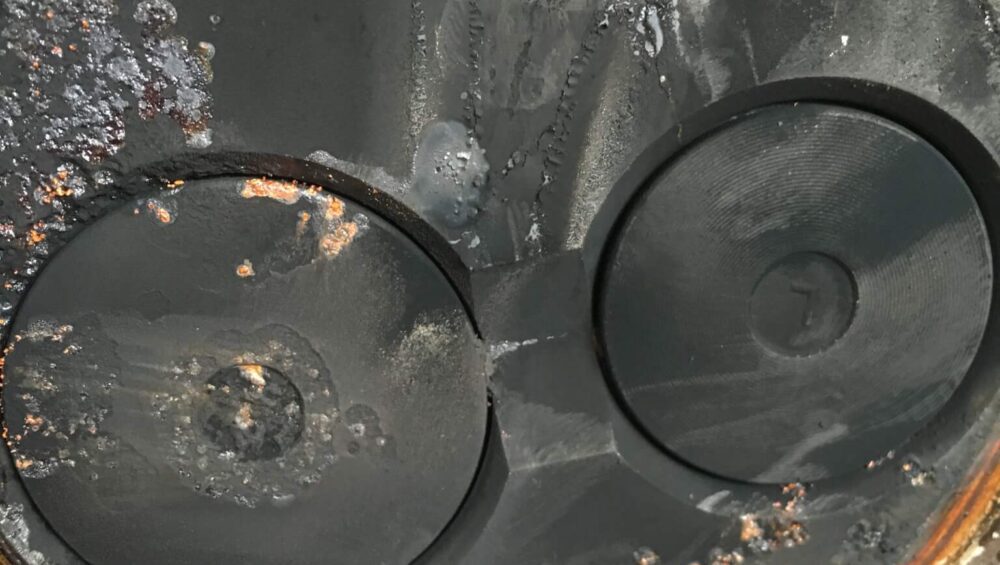
The 1HZ has a great reputation for a solid worker. It also has a history of cracked heads and pistons with the early turbo systems with plenty of experiences of overheating.
The 1HZ is Toyota’s indirect injection 4.2L, as opposed to the 1HD series that are all direct injection. Toyota’s casting is very good but in the case of the 1HZ there is very little water jacket around the exhaust port, which means that when fuelling is increased (for more power) without sufficient air, the combustion temperatures rapidly rise and subsequent EGT becomes excessive. The steel around the exhaust port gets hot and expands, without the water presence and flow to equalise the temperatures in the steel around – this uneven rapid heating places the steel under stress and may result in a crack.
For demonstration a 1HZ cylinder head was cut through the exhaust port. While cutting, the built up internal stress resulted in the area opening up before the cut was complete. An inspection of the cross-section shows the small water gallery around the port. Looking inside the water gallery a layer of rust and scale can be seen, which acts to reduce the gallery size and (more critically) insulates the steel. The scale is very hard and can only be lifted with a chemical treatment.
To have a successful experience with a turbo 1HZ:
- Use a turbocharger that boosts early and is on boost under normal driving rpm.
- Tune the system to have a lean burn when loaded up.
- An efficient intercooler to get maximum cooling and lower EGT.
- Run 15-18psi as this works well with the fuel capabilities of the std 10mm pump.
- Don’t let the engine lug in the lower rpm with rich mixtures.
- Run Toyota Red Long Life Coolant (that’s not the Extra Long life coolant). Don’t mix coolants and flush if you have.
- Clean the cooling system with a quality engine flush to remove rust and scale (R20 is a great corrosion dissolver and can be left in the engine for a week or more).
- Run a genuine thermostat.
- Consider adding extra fluid to the viscous coupling to make it pull more air.
If you still have cooling issues, then it has been suggested yours could have a casting variation limiting its ability to cool. While nobody is likely to investigate this, it could be that engines susceptible to overheating may have a reduced coolant volume in the head.